The dust has settled from CES 2026, and the hype machine for Nvidia’s RTX 50-Series “Blackwell” laptops is in full swing. Manufacturers like ASUS, Lenovo, and MSI are already opening pre-orders for machines shipping in February, promising generational leaps in AI performance and ray tracing. If you look strictly at the marketing slides, it looks like a revolution. But if you look at the spec sheets—specifically for the mid-range RTX 5060 Mobile—it looks remarkably like a trap. Before you drop $1,400 on a new 2026 model, you need to look at the one number Nvidia is trying very hard to hide: Video Memory.
The 8GB VRAM Cap is Insulting in 2026
The single biggest disappointment from the leaked spec sheets is that the RTX 5060 Mobile appears to retain the same 8GB VRAM limit as its predecessor, the RTX 4060. In 2023, 8GB was “fine” for 1080p gaming. In 2026, with Unreal Engine 5 titles becoming the standard and GTA VI looming on the horizon for late 2026, 8GB is practically a death sentence for high textures. By refusing to bump the mid-range cards to 12GB, Nvidia is essentially engineering obsolescence into these machines on Day 1. You might get faster frame generation, but you will still hit the same texture walls that plagued the 40-series.
The Price-to-Performance Trap
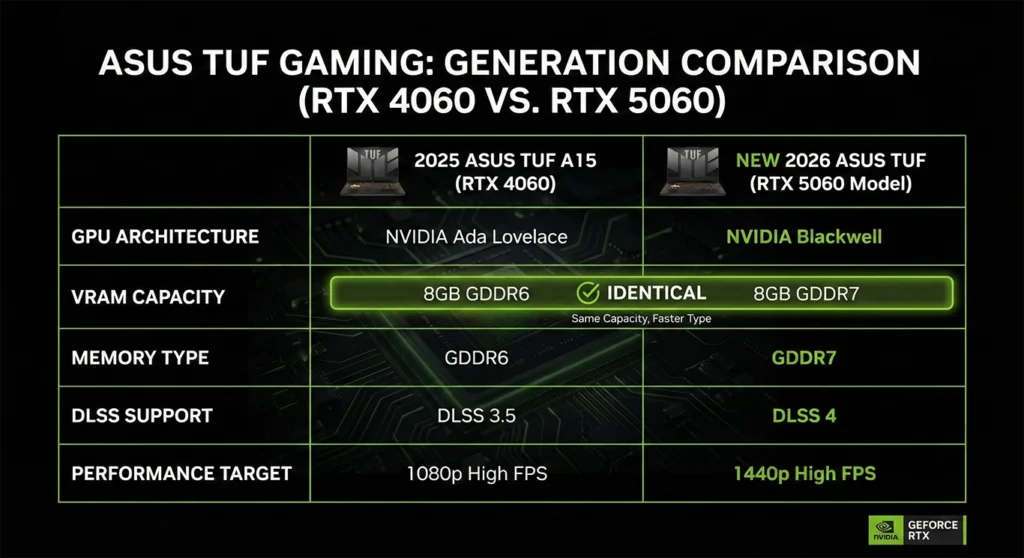
The math simply doesn’t add up for the early adopters. A new ASUS TUF A16 or Legion Slim 5 with an RTX 5060 is currently listed for pre-order around $1,300 to $1,500. For that same price right now, you can pick up a clearance RTX 4070 or even a heavily discounted RTX 4080 laptop from the 2024/2025 stock. Those older cards often have wider memory buses and raw rasterization power that “Blackwell” architecture efficiency can’t overcome in the mid-range. You are paying a “New Tech Tax” for a GPU that might actually struggle more in 1440p gaming than a laptop that has been sitting on a shelf for a year.
Wait for the Real Benchmarks
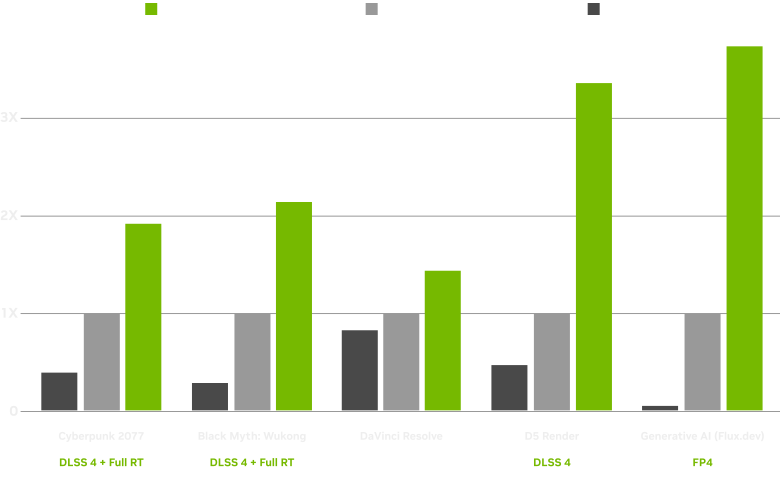
The “Veteran” move here is patience. Nvidia’s marketing relies heavily on DLSS 4.0 and Frame Gen to inflate their performance charts. We need to see raw, native benchmarks from independent reviewers before we know if the 50-series is a worthy upgrade. If the RTX 5060 offers only a 10-15% rasterization bump over the 4060 but costs 30% more, it is objectively a bad buy. Unless you absolutely need the latest NPU for local AI workloads, hold onto your wallet. The smart money is waiting for the inevitable price drops or hunting for a used flagship from the previous generation.
About the Author