In 2025, Amazon’s push into warehouse automation is reaching a critical inflection point. Reports and internal documents suggest the e-commerce giant is accelerating the deployment of robots, with plans to cut labor costs, boost efficiency, and potentially reduce staffing needs in some fulfillment centers by a staggering 40% or more.
This move isn’t just about convenience. It signals a deeper transformation of Amazon’s labor model, raising difficult questions about the future of jobs, the balance between humans and machines, and what “work” will even look like in a highly automated world.
In this article, we dig into the latest reports, leaked strategies, and worker reactions — and explore what all this means for Amazon’s warehouses, employees, and society at large.
The Automation Surge: What’s Actually Happening
Massive Robot Deployment
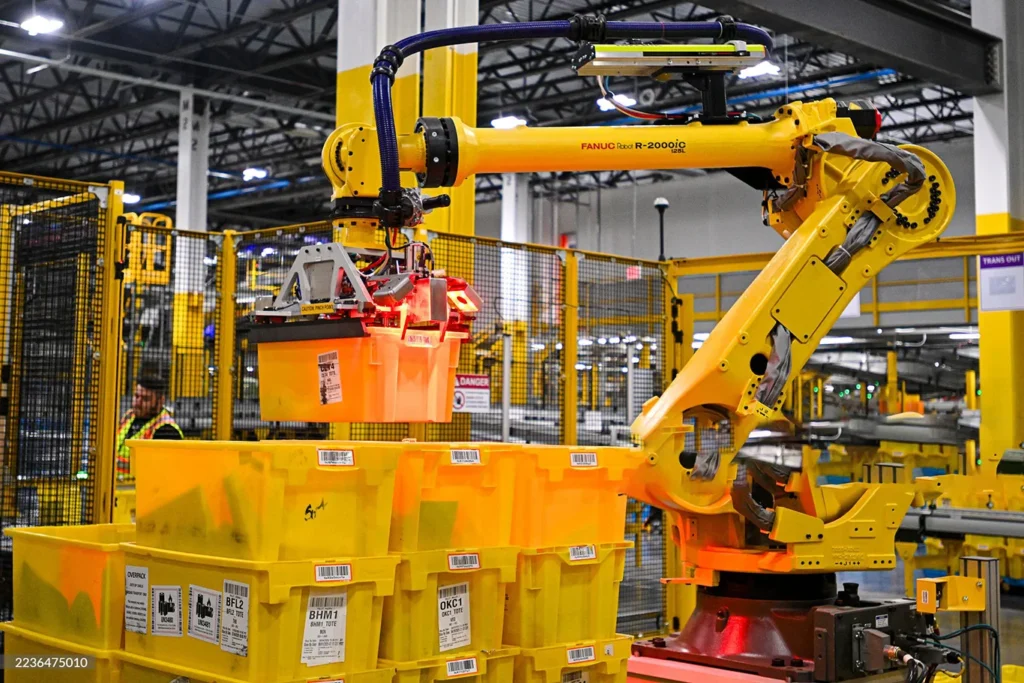
- According to The Wall Street Journal (via PYMNTS), Amazon now has over 1 million robots operating in its fulfillment centers — a number that is approaching parity with human workers.
- These machines include wheeled “drive” robots that transport inventory pods, robotic arms that pick and stow items, and new “cobots” that work directly alongside people.
- A newer model, called Vulcan, even has a tactile “hand” that lets it feel items, enabling it to pick a wide variety of SKUs.
Huge Job Reduction Plan
- Leaked internal Amazon documents (reported by The New York Times) reveal plans to avoid hiring 160,000 warehouse workers by 2027, thanks to automation.
- Over the long term, Amazon may replace over 600,000 U.S. jobs using robots, according to the same strategy papers.
- By 2033, Amazon’s robotics team aims to automate up to 75% of its operations.
- According to a Moneycontrol report, automation could continue expanding to about 40 robotic warehouse facilities by 2027.
Efficiency Gains — and Cost Savings
- The Shreveport, Louisiana warehouse is a key test site: after robot deployment, Amazon reportedly needed 25% fewer workers while handling more volume.
- Leaks suggest automation could save Amazon $12.6 billion in labor costs between 2025 and 2027, breaking down to ~30 cents saved per item processed.
- According to Amazon’s internal safety data (via a Fairwork / GPAI report), automation has also reduced severe injury rates in robotic fulfillment centers by ~40%.
What Amazon Says — And What It Doesn’t
Amazon executives and robotics leaders have publicly framed this transformation as augmentation, not replacement.
- At a recent robotics event, Tye Brady, Amazon Robotics’ Chief Technologist, emphasized that robots are meant to “take on the menial, repetitive tasks” while workers handle judgment-based roles.
- According to Amazon, there’s no plan to create “lights-out” warehouses with zero human workers. Brady stated: “There’s no such thing as 100 percent automation.”
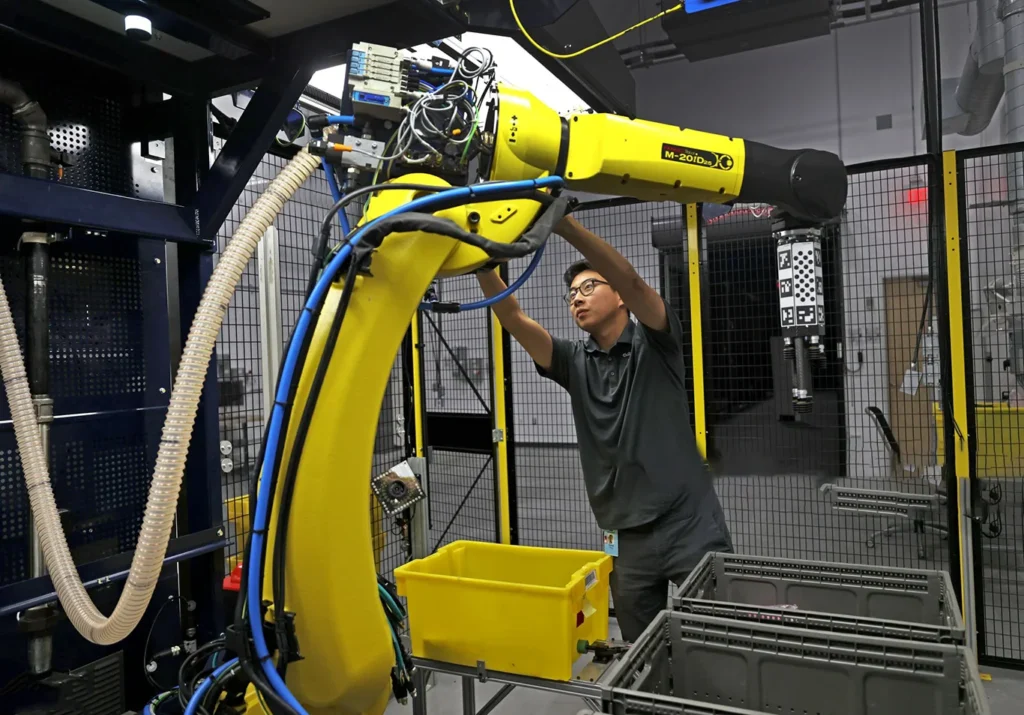
- The company has launched large-scale training programs, reskilling over 700,000 employees to work as robotics technicians, mechatronics engineers, and system supervisors.
Amazon also argues that automation improves workplace safety. According to its internal data, robotic fulfillment centers report fewer serious injuries, though some non-severe injury categories have risen.
Worker Reaction: On the Ground Realities
Warehouse workers and labor advocates are watching closely — and many are deeply concerned.
- In forums like r/AmazonFC on Reddit, several workers say their roles are being phased out. One post reads:
“They already are replacing us. … The company leases the robots for $3/hr … They work 24/7.”
- Another user worries about job security, writing:
“That thing is slow … and yet still faster than some actual employees because that thing doesn’t need 1 hour break.”
- On the flip side, some workers have been retrained for technical roles and now monitor robots instead of lifting boxes manually.
Union leaders and labor groups are raising red flags: the rapid automation could disproportionately impact blue-collar workers, especially those in high-robot-density facilities.
The Global Trend: Not Just an Amazon Story
Amazon isn’t alone. Globally, robotics is reshaping warehouses.
- In Japan, Amazon’s Chiba fulfillment center is a testbed for advanced automation: robots now outnumber human workers, and a new AI model called DeepFleet helps coordinate them.
- Advances in humanoid robots — machines with two legs and arms — are gaining traction. Amazon is reportedly exploring these, potentially extending automation to delivery roles as well.
The Bigger Picture: Economy, Ethics & the Future of Work

Economic Efficiency vs. Social Cost
- Amazon stands to boost efficiency and save billions — but at what cost?
- As more warehouses follow Amazon’s model, the question arises: Are we building a future where human labor becomes optional?
Labor Market Polarization
- Automation may eliminate large numbers of low- to mid-skill jobs.
- However, demand for technical roles (robotics maintenance, AI oversight, systems engineers) could surge — possibly widening inequality.
Worker Protections & Rights
- Amazon claims it promotes upskilling, but critics argue automation could accelerate job displacement faster than workers can adapt.
- The risk: “reskilled” workers may still be vulnerable, turning them into tech overseers with precarious prospects.
Regulatory Pressure
- Governments and labor groups may soon demand transparency on automation plans, especially given reports of mass job reductions.
- Ethical questions: Should companies like Amazon pay a “robot tax” or contribute more to community welfare?
What This Means for Amazon’s Warehouses by 2030
- Facilities Trend: By 2027, Amazon expects to replicate its high-automation model in ~40 warehouses, significantly changing its staffing structure.
- Job Mix Shift: Fewer traditional pickers and packers; more robotics technicians, system supervisors, and AI operators.
- Safety Trade-offs: Injuries may drop in severity, but workers say performance metrics have become more demanding.
- Long-Term Impact: If automation goals are met, humans may be managing, not doing, most warehouse tasks by early 2030s.
Amazon is not just automating its warehouses — it’s reimagining work itself. The scale and speed of this transformation are staggering: over 1 million robots, major job avoidance plans, and full robotic fulfillment centers being rolled out globally.
While Amazon paints a future of shared human-machine labor, the reality on the ground is more complicated. Workers are getting upskilled — but many worry their roles are disappearing. In the coming years, we’ll likely see a major shift in what it means to “work at Amazon.”
This isn’t just a story about robotics. It’s a human story. And for millions of workers, the stakes couldn’t be higher.
About the Author